
I bought my first deck on a Tuesday night, mostly because I couldn't stop scrolling through layoff posts on LinkedIn. Everyone in my feed was either "excited to announce" a new role after being let go, or quietly disappearing from the platform altogether. I wasn't laid off. But I kept refreshing my inbox like I was waiting for bad news anyway. So I did the thing I never thought I'd do: I shuffled a tarot deck, asked my messy, half-formed question out loud, and pulled three cards. Then I just... sat there. I had no idea how to read tarot cards I'd already drawn. The cards were face up on my kitchen table, and I felt more confused than when I started.
If that sounds familiar, you're not alone. A lot of people don't struggle with tarot because they don't believe in it — they struggle because nobody ever taught them what to actually do once the cards are already out of the deck.
## The Three Card Tarot Spread Meaning I Wish Someone Had Explained to Me First
Before that night, I assumed reading tarot required memorizing all 78 cards like flashcards. It doesn't. Almost every beginner spread, including the one I pulled, follows a simple logic once you know where to look.
My question was something like: "What do I need to understand about my career right now?" I drew three cards, left to right, and treated them as:
- **Card 1 — Where I am now.** This is the emotional starting point, the thing sitting underneath the anxiety.
- **Card 2 — What's actually happening beneath the surface.** Not what I think is going on, but what's real.
- **Card 3 — What I need to do or accept.** Less "fortune telling," more "here's your next honest step."
That's the three card tarot spread meaning in its simplest form — past-present-future, or situation-challenge-guidance, depending on the deck's little guidebook. Once I stopped trying to remember every symbol and started reading position by position, the cards actually started making sense.
I drew the Eight of Swords, the Wheel of Fortune, and the Nine of Pentacles. On paper, that's a strange combination. The Eight of Swords is usually about feeling trapped by your own thoughts, not your circumstances. The Wheel of Fortune is about cycles turning, whether you're ready or not. The Nine of Pentacles is quiet, self-made stability — someone who built security with their own hands. Read as a sequence, it stopped looking random. It looked like a message: *you feel stuck, but the situation is already shifting, and the stability you're afraid of losing is something you can rebuild yourself.*
## Why My Cards Kept Circling Back to Career Anxiety
I want to be honest about something. I didn't ask the cards "will I get laid off." I asked something vaguer, and the cards still landed on career anxiety anyway. That's not the deck reading my mind — it's that tarot works best when you let the images sit next to whatever is actually loudest in your life, and for a lot of us right now, that's job security.
This is one reason tarot reading for career anxiety has quietly become one of the more common uses for beginner spreads. It's not really about predicting an outcome. It's a structured way to sit with a worry you've been avoiding and look at it from three different angles instead of one anxious loop. The Eight of Swords didn't tell me I was safe or unsafe at work. It told me the fear itself was the thing keeping me stuck, and that's a very different, much more useful thing to know at 11pm with a laptop open.
Here's where I got stuck for real, though: I could name the cards, but I couldn't confidently connect the three of them into an actual reading. I kept second-guessing whether I was projecting meaning onto random pictures, or whether there was something more structured I was missing.
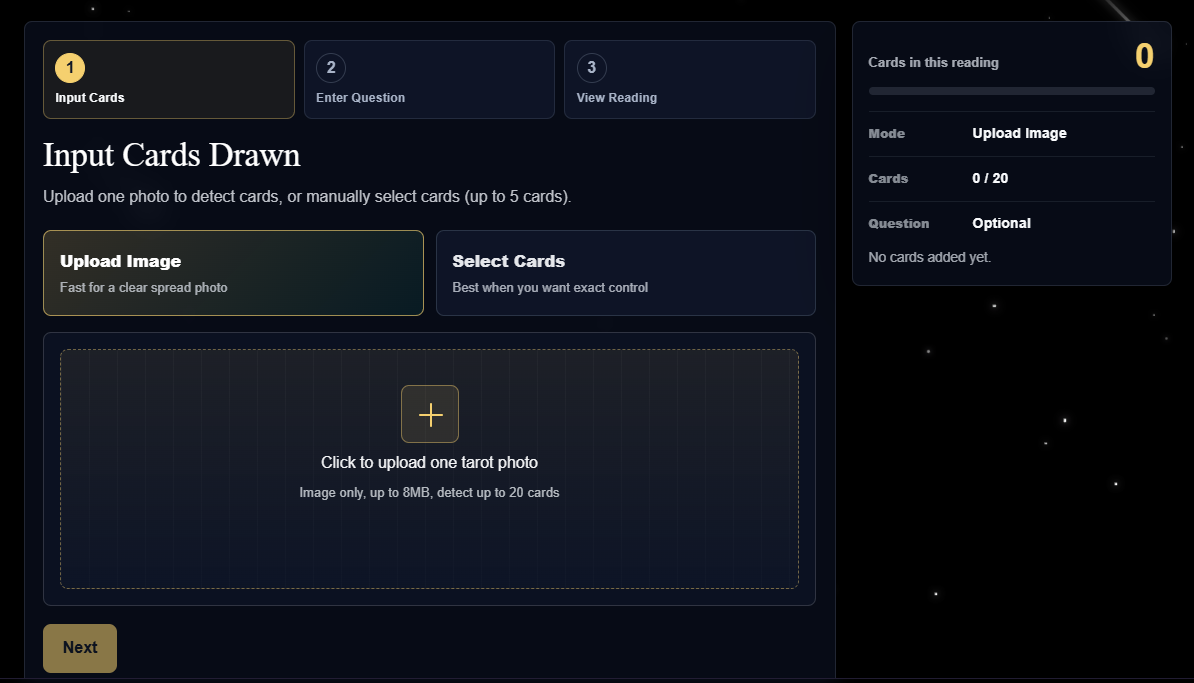
That's honestly the exact gap that pushed me toward trying a [manual tarot card reading online](https://tarotcardpro.com/manual/) instead of just googling each card separately. I photographed my three cards exactly as I'd laid them out — same order, same orientation, upright Wheel of Fortune and all — and let it walk me through the spread position by position, the way an actual reader would, instead of giving me three disconnected keyword definitions. If you've ever pulled cards for a real question and then closed twelve browser tabs trying to make them agree with each other, this is basically built for that exact moment.
## Common Questions About Reading Your Own Tarot Cards
**Do I need to memorize all 78 cards before I can read for myself?**
No. Most people start by understanding spread positions first (what each slot in the layout is asking) and let the card meanings fill in around that structure. Memorization comes later, if it comes at all.
**Does it matter if my card is upside down (reversed)?**
It can shift the tone — often toward something delayed, internalized, or blocked rather than fully absent. Plenty of readers, especially beginners, choose to read every card upright only, and that's a completely valid approach too.
**Can I read tarot cards for myself, or do I need someone else to do it?**
You can absolutely read for yourself. The main challenge is staying neutral about your own situation, since it's easy to only see what you want or fear seeing. Writing down your interpretation before you look anything up can help you notice your own bias.
**What if the three cards seem to contradict each other?**
That's normal, and usually the most interesting part. Contradiction often means the situation genuinely has two sides — try reading it as "this is true, and so is this," rather than trying to force one card to cancel out the other.
## Bringing It Back Together
I still don't have every symbol memorized, and I'm honestly fine with that now. Learning how to read tarot cards you already drew isn't about becoming an expert overnight — it's about giving yourself a slower, more structured way to sit with a question instead of spiraling on it alone. My three cards didn't tell me whether my job was safe. They told me where my anxiety actually lived, and that turned out to be more useful.
If you've got cards sitting on your table right now and you're staring at them the way I stared at mine, you don't have to guess your way through it. Lay them out exactly as you drew them, walk through each position slowly, and if you want a second perspective on your own real spread, [our manual tarot reading tool](https://tarotcardpro.com/manual/) is there to walk through it with you, card by card, in the order you actually pulled them.